
Pickle Court
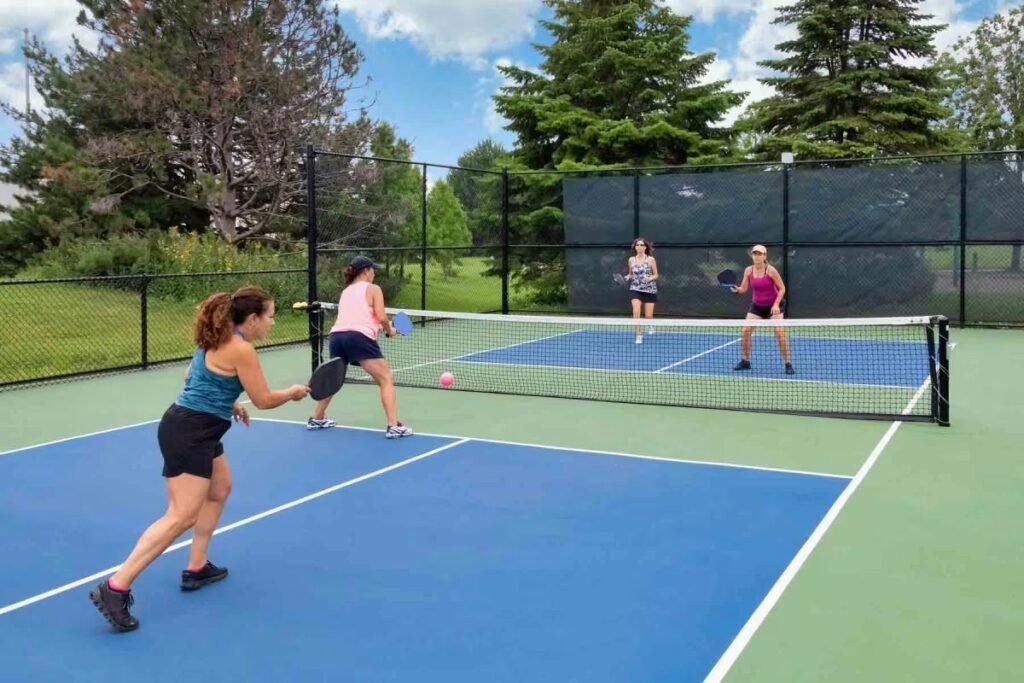
The dedicated playing area for pickleball matches functions as a court which enables players to play the sport that has emerged as a popular hybrid game which combines tennis badminton and table tennis. The court size remains smaller than a tennis court which enables players of all ages and skill levels to learn the game more easily. Pickleball involves two game formats which players use to compete against each other while using solid paddles and lightweight plastic balls that contain holes. The small court size results in fast-paced games which require players to use strategic shots while maintaining their active presence on the field.
The standard dimensions of a pickle court are 20 feet wide and 44 feet long for both singles and doubles matches. The court is separated into two equal parts through a net which runs from the center point to the edges of the court.
The net reaches a height of 36 inches at the edges and 34 inches at the center point. The court design includes service areas on both sides which players use to determine their positions for serving and receiving during the match. Players must stay outside the designated non-volley zone which extends 7 feet from the net to both sides because this rule forms a vital part of the game strategy.
Pickleball courts use concrete or asphalt surfaces which athletes need because these surfaces require special sports surfacing materials to create proper traction and uniform ball bounce. Clear court markings help players easily identify service boxes, baselines, sidelines, and the non-volley zone. Outdoor courts find their most common installation in parks and sports complexes and residential communities while recreational facilities and gyms see rising demand for indoor courts.
Outdoor courts need lighting systems and fencing because these additions enhance visibility and prevent balls from leaving the designated playing space. Worldwide popularity has grown for pickleball because its basic court design and simple game rules allow beginners to learn the sport while advanced players can compete at their highest level.
What is the process followed by Pickle court installers?
A pickle court installers demands precise planning together with exact measurements and appropriate building techniques which create a court that maintains safety and durability while delivering excellent playing conditions. The installation team employs a systematic approach to establish proper court dimensions which ensure players can enjoy uninterrupted game time across different playing styles.
1. Site Evaluation and Planning
The team conducts an initial site assessment to determine the court construction area. The team examines three factors which include available space plus existing ground conditions and drainage systems and site access points. The team measures the space to verify its ability to hold a standard pickleball court which requires 20 feet by 44 feet plus additional area needed for player movement and safety.
2. Ground Preparation and Base Construction
The team begins site work after they receive site approval because they need to clear and level the ground. The base must provide a strong foundation because it needs to support the structure through time. Most pickleball courts exist on either concrete or asphalt base foundations. The team prepares the surface with great precision to achieve a level surface which includes proper drainage elements.
3. Court Surfacing
The team installs sports surfacing materials after they finish building the base. The coatings create surfaces which enable optimal traction for players together with uniform ball bounce and protection against different weather conditions. The surface requires multiple layers to achieve both durability and professional playing standards.
4. Court Marking and Line Painting
Court markings become visible after the surface dries to its complete state. The lines establish the boundaries which include the baseline and sidelines together with both service areas and the kitchen area which serves as the non-volley zone. The court needs exact line markings because official pickleball standards require this standard to be met.
5. Net System Installation
The net system requires installation as the next procedure. The installation team secures the strong posts to both court sides while they install the net at its proper height which measures 36 inches at the sidelines and 34 inches at the center.
6. Lighting, Fencing, and Final Inspection
The final stage may include installing perimeter fencing and lighting systems for better visibility and ball containment. The installers perform a thorough inspection process to verify that the court surface together with its markings and equipment fulfill both quality and safety requirements.
What surface is best for a Pickle court setup?

The selection of an appropriate surface material stands as a critical element within the process of establishing a pickle court setup because it determines how players will perform and their safety and how long the court will remain operational. The prepared surface maintains consistent ball bounce and provides players with secure footing while withstanding different weather conditions. Pickleball courts most commonly use concrete and asphalt as their surface materials because these options create stable and secure playing environments.
Concrete functions as the best material for pickleball courts because its strength enables consistent performance during its entire lifetime. The creation of a concrete base through proper construction methods delivers an exceptionally flat playing surface that maintains controlled pickleball bounce.
Concrete surfaces serve as a preferred option for public and private courts because they need minimal upkeep after installation. The concrete courts which feature specialized acrylic sports coatings provide players with both maximum grip and optimal comfort while protecting the surface from weather damage.
Asphalt stands as another popular option for pickleball courts because its lower costs make it an affordable alternative to concrete. The combination of proper installation and maintenance work enables asphalt to create a smooth playing surface which maintains its quality for an extended period. The final touch of asphalt surfaces involves acrylic sports coatings which deliver two benefits through enhanced player traction and ball bounce while simultaneously creating color for court lines and playing areas. The coatings create protective barriers which stop base surfaces from suffering damage through physical contact and natural environmental factors.
The court system functions properly when both its fundamental materials and its athletic surface materials reach proper standards. The common use of acrylic coating systems occurs because they create a non-slip surface which enables better player movement while decreasing their chances of sustaining injuries. The coatings provide court marking solutions which remain visible throughout time because of their transparent and durable properties.
A proper pickleball court needs a surface which maintains both smoothness and levelness while it provides proper slopes for water drainage. The combination of a strong base and a high-quality surface coating makes the pickleball court a dependable and safe playing area which provides safe and enjoyable experiences for multiple years.
What services are included in Pickle court service?
The Pickle court services provide professional solutions which create new pickleball courts and restore existing ones and improve their overall performance. The services maintain court safety while extending its life and making it suitable for all types of play. The pickleball court service providers take charge of every necessary task which leads to developing an optimum playing field from the first planning stage until the ongoing maintenance phase.
1. Court Design and Planning
The primary service offers pickleball court design which follows established court dimensions and player specifications. The process includes designing the court layout together with choosing the right surface materials and establishing proper space requirements for safe player movement. Proper design also considers lighting placement, fencing, and drainage systems.
2. Site Preparation and Construction
The site preparation process begins with professionals who conduct clearing operations and leveling work and grading activities to create a suitable ground base for court construction. Professionals create a solid foundation using materials which include concrete and asphalt. This stage ensures the base is stable and capable of supporting the court surface for many years.
3. Sports Surface Installation
The installation of specialized sports surfacing systems stands as another crucial service. The base surface receives acrylic coatings or similar materials which establish proper grip and consistent ball bounce and long-lasting durability. The coatings shield the court surface against damage which results from weather conditions and damage that happens through normal court use.
4. Court Marking and Line Painting
Accurate line marking is essential for proper gameplay. The professionals use high-quality sports surface paint to create boundary lines and baselines and service areas and the non-volley zone. The players use clear and precise markings to follow official rules which enhances their ability to play the game.
5. Net System and Equipment Installation
The net system installation together with all necessary equipment setup forms part of the pickleball court services. The installation of strong posts together with properly tensioned nets ensures that players can compete under standard height specifications which create equitable conditions for all participants.
6. Maintenance and Repair Services
The court requires regular maintenance services to maintain its optimal condition. The maintenance work includes surface cleaning and crack repairs and area resurfacing and court line repainting. The court maintenance work extends its operational life while maintaining safety and player enjoyment.